How the circuit represents a graph
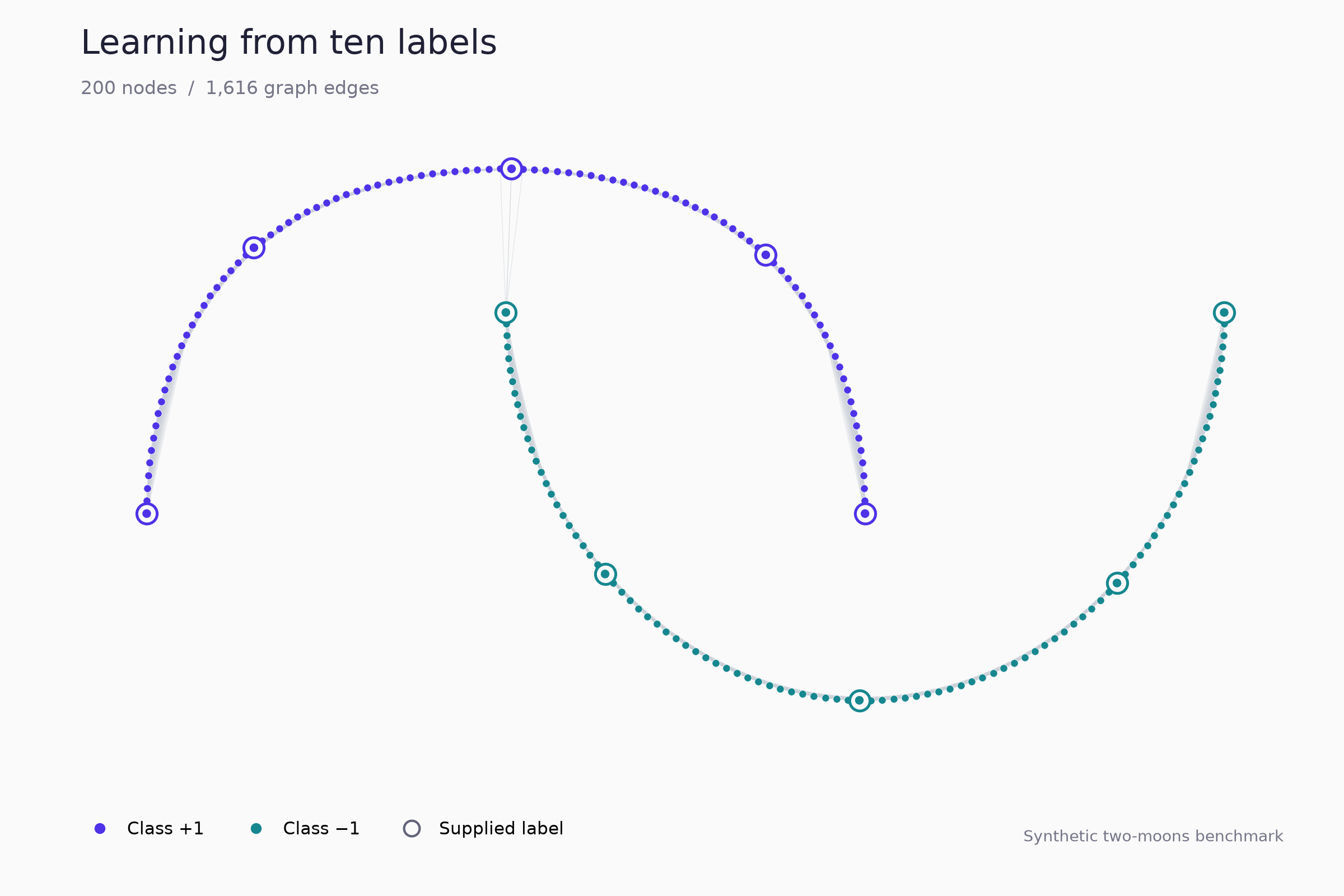
Conductances connect nearby data points, and known labels supply inputs at a small subset of nodes. The remaining voltages evolve toward a graph-based solution. In this synthetic benchmark, ten supplied labels are enough for the final output signs to classify all 200 points correctly.
Classification and settling time
All output signs become correct at about 1.29 microseconds in this test. Reaching within 1 mV of the final circuit state takes 45.8 microseconds. That final state still differs from the ideal graph solution by up to 67.7 mV, so classification accuracy alone does not describe the circuit's numerical accuracy or settling time.
What limits the dynamics
The preprint examines how finite amplifier bandwidth and network loading constrain the modeled reciprocal networks. A row-local spectral certificate bounds the fastest reduced-model rate, while the slowest mode controls asymptotic settling. For explicit sampled updates, the corresponding Courant metric gives a stability condition. The analysis applies to these networks; other analog architectures require their own models.