
Implementing the matrix in a circuit
Our approach targets linear systems, including those obtained by discretizing physical conservation laws. CMOS buffers and programmable conductances implement the matrix connections, and their behavior affects both accuracy and settling time. Steady-state heat conduction provides a demanding elliptic test case for evaluating the approach’s robustness and applicability.
Results from two circuit models
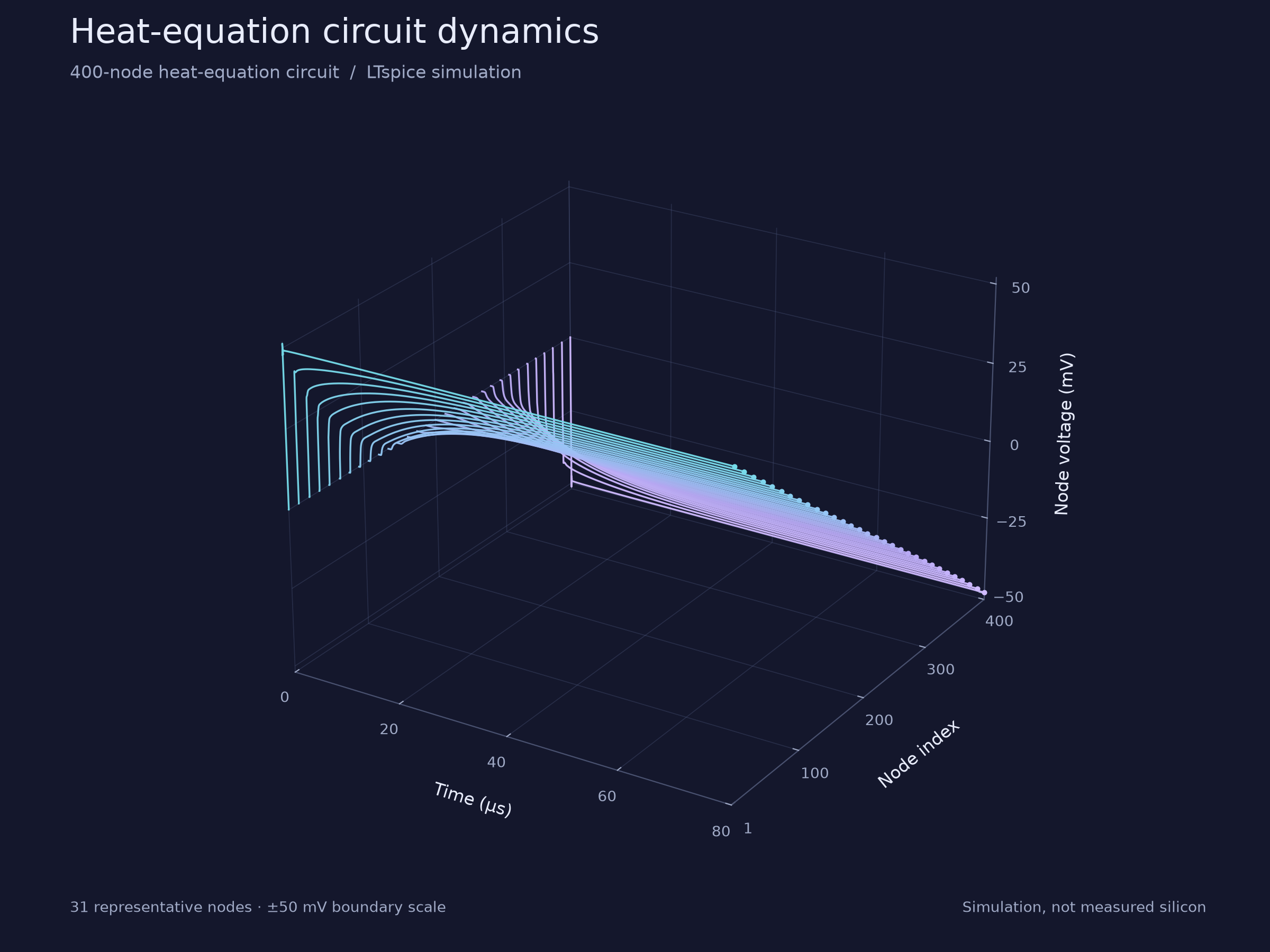
The 400-node class-AB study reaches a 2 mV all-node error envelope at 27.3 microseconds after input. A companion 200-node, accuracy-trimmed servo sandbox reaches its own 2 mV envelope at 18.2 nanoseconds. The circuit models and operating conditions differ, so these times do not establish a matched speedup.
Further circuit validation
The models make it possible to study buffer behavior, loading, and accuracy together. They use generic MOS devices and idealized bias elements. Assessing manufacturing readiness or a hardware energy advantage would require foundry models, extracted parasitics, device mismatch, noise, and measurements from fabricated silicon.