Developing accurate analytical methods for electron trajectories in quadratic fields, accounting for curved geometry and element-boundary crossings.
Sumer Analog · Research
Designing vacuum electronic devices requires accurate models of electrode geometry, electric fields, and electron motion. Sumer Analog’s in-house high-order finite-element solver combines electrostatic field calculations with analytical particle tracking to study these interactions.
Our longer-term goal is to support the development of nanoscale vacuum devices for high-frequency electronics and explore their potential in future AI accelerators. The triode simulation below illustrates the underlying modeling approach.
Drag to rotate. Scroll or pinch to zoom. Scrub the timeline to follow the electron trajectories.
Loading simulation…Geometry in millimetres
Loading the mesh and particle trajectories…
CathodeGrid wireAnodeElectrons and paths
Drag: rotate · Shift-drag: pan · Scroll or pinch: zoom. Focus the scene and use arrow keys to rotate; +/− to zoom.
Selected trajectories—
Simulation time window—
Tetrahedra11,008
Spheres are enlarged for visibility; playback is slowed down.
Simulation conditions
The animation follows particle trajectories from an evolving-field simulation.
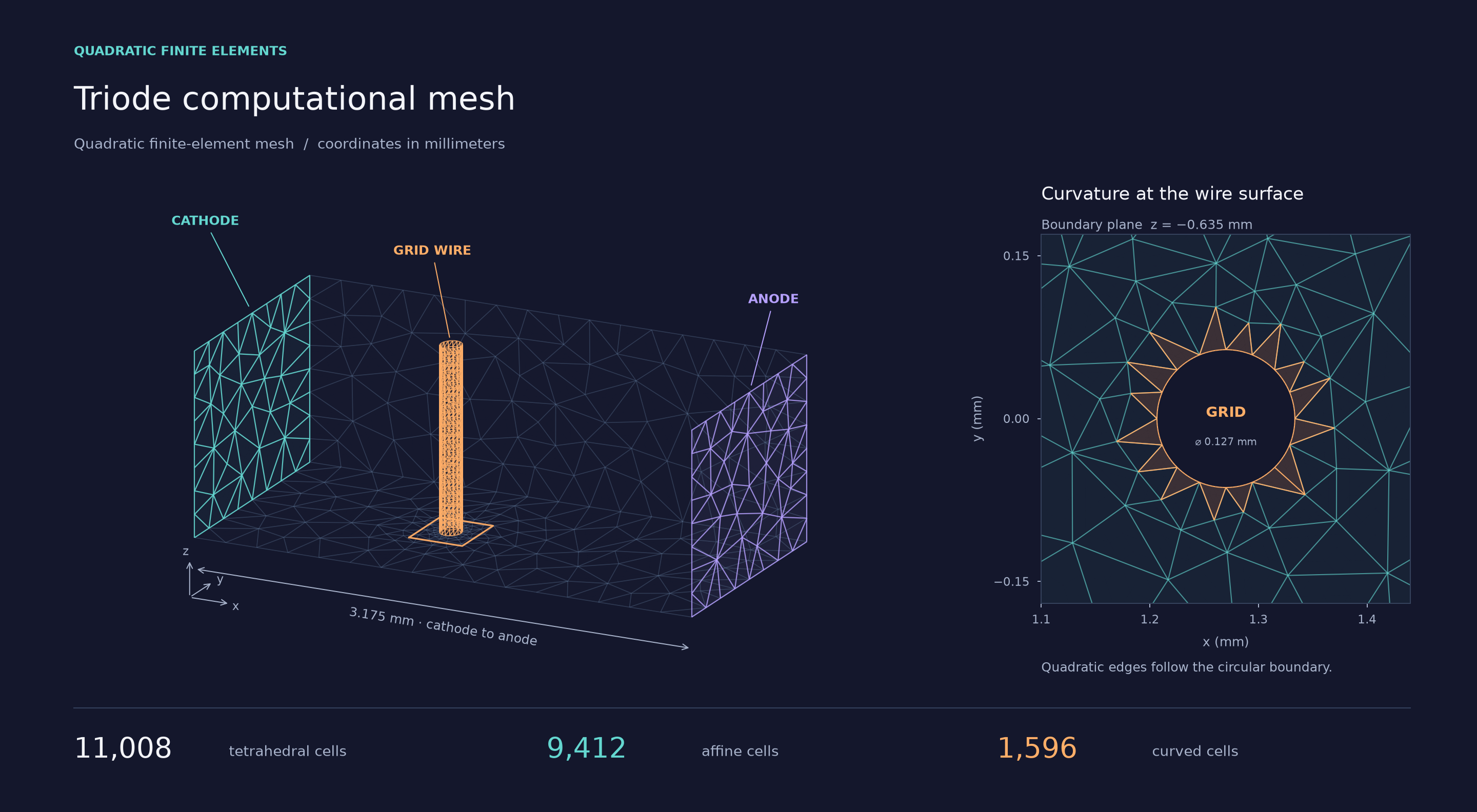
The computational mesh
Quadratic finite-element mesh with 11,008 tetrahedra: 9,412 affine and 1,596 curved cells. Cathode-to-anode distance is 3.175 mm; grid-wire diameter is 0.127 mm. The closeup shows the boundary plane at z = −0.635 mm.
Motion within a finite element
A frozen quadratic potential in a straight-sided tetrahedron gives electron motion an exact local analytical form. The method uses that solution within each cell and numerical searches to find boundary crossings. Curved elements use Runge–Kutta integration.